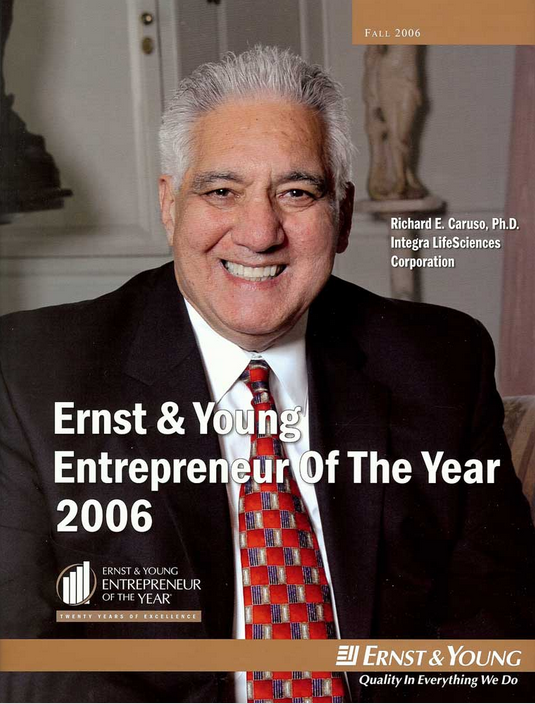
Dr. Richard Caruso
MEET OUR FOUNDER
How does the son of humble Italian immigrants rise to become the Ernst & Young 2006 Entrepreneur Of The Year? It all starts with a dream.
News
THE LATEST FROM UIF
Click here for immediate access to our latest press releases and other helpful material about the foundation and its programs.
Staff Bios
MEET OUR DREAMMAKERS
Every dream needs enthusiastic people to make them come true. Meet the women and men that power our programs.
Press Kit
HELP SPREAD THE STORY
Logos, photos, backgrounders—just about everything the working press needs to help explain the many benefits of mentoring.
![]()


Dr. John Crosby
EXECUTIVE DIRECTOR
My dream is to help individuals identify and use their strengths to reach their fullest potential.
Full BioDimitri Vissiliou
CHIEF OPERATING OFFICER
My dream is to continue helping people overcome obstacles on the way to reaching their full potential.
Full BioCarmen Dawson
Entrepreneurial Education
Entrepreneurs can leverage mentoring to gain resources to achieve any goal, gain access to networks and information.
Full BioKatya Piskacheva
lead researcher and program coordinator
My dream is to teach people the power of mentoring though effective communication and true listening.
Full BioMark Moore
Opti-Match/Mentor Matching
My dream is helping people find the mentors who will help them change the world.
Full BioShari Green
e-LEARNING COORDINATOR
My dream is to further the application of classroom learning to create a better world.
Full BioAndrew Zivic
e-LEARNING COORDINATOR
My dream is helping students get a post-secondary education, one module at a time.
Full BioWhile the Uncommon Individual Foundation is protégé-centric in focus, we often are brought in by companies and organizations who desire to develop a mentoring culture within their existing structures. Both for-profit and not-for-profit companies have benefited from our experience and expertise in the "art and science of mentoring." Here are a few examples.
Uncommon Individual Foundation
769 E. Lancaster Avenue
Suite 204
Villanova, PA 19085-0190
(610) 520-0180
DEFINITION:
Protégé-Driven/
Focused yet Flexible
Open mentoring is a dynamic exchange of enriching resources. In open mentoring, a single protégé employs a variety of mentoring resources and relationships—simultaneously and over time. This type of mentoring often occurs naturally as protégés take the leadership role in their endeavors and strive to fulfill their dreams.
- Protégé > Expert
- Protégé > Inspirational resource
- Protégé > Child
Open Mentoring in Action
KEY BENEFITS/POSSIBLE LIMITATIONS
- Protégés who assume leadership over their mentoring endeavors are often more motivated and energized to work to achieve their dreams. The journey becomes their true magnum opus.
- By engaging a range of resources simultaneously, protégés fortify their arsenal of skills, ideas, inspirations, and expertise. Often, they find that the resource-rich environment is superior to the value received from any single source.
- Mentor burnout is less common when multiple resources are employed. And the loss of a mentoring resource does not devastate the initiative to the extent that it would in a closed (one-to-one) arrangement.
Key Benefits
- Because of the considerable responsibility and accountability placed on the protégé, this type of initiative can be more difficult to manage than a one-to-one arrangement.
- Drawing together numerous resources to succeed, the protégé’s engagement with any one resource may be less intimate and less intense relative to closed-system mentoring.
Possible limitations
In an Open Mentoring system, the protégé is the key initiator, process director (and re-director) and chief beneficiary.

DEFINITION:
Top Down/
Mentor Led
Mentoring is traditionally characterized as a relationship where an older, more experienced person guides the progress of someone younger and less experienced. Most people think of mentoring as a one-to-one, top-down relationship that’s largely defined from the mentor’s perspective. While this style of mentoring can yield positive results, it represents only one possible model (that uses only a portion of the power of mentoring.)
Closed mentoring is an arrangement between one mentor and one protégé, in which the mentor typically assumes greater control over the mentorship relative to the protégé. Within this classic framework, the mentor is the dominant influence and the protégé is the primary beneficiary of the mentoring activity.
Closed Mentoring in Action
- Coach > Player
- Teacher > Student
- Parent > Child
KEY BENEFITS/POSSIBLE LIMITATIONS
- Closed mentoring can be very rewarding for both the protégé and mentor.
- The relationship is very intimate and both members are highly invested in the protégé’s development.
- These proprietary arrangements are often very manageable.
Key Benefits
- As the leader of the relationship, the mentor typically assumes much of the responsibility. This may result in mentor burnout.
- The protégé has little room to exercise personal initiative, which inhibits the realization of true potential.
- Protégés limit their opportunities when they engage only a single resource.
Possible Limitations
Closed mentoring is
particularly useful in
learning situations.
The mentor acts as a teacher and assumes responsibility, while the protégé becomes a receptive student.
DEFINITION:
Everyone’s a protégé
—and a mentor
Collaborative mentoring is a sort of hybrid, combining the high investment levels shared by participants of closed mentoring with the multiple resources of open mentoring. This type of group-oriented mentoring occurs when people with unique, but complementary, dreams act as each other’s mentoring resources. In collaborative mentoring, leadership is shared among participants and each of them shifts appropriately between the roles of mentor and protégé.
- Professional meetups
- Classic networking
- Cross-disciplinary collaboration
Collaborative in action
KEY BENEFITS/POSSIBLE LIMITATIONS
- Since participants share leadership, power struggles and other related conflicts are less likely to occur.
- Multiple resources expand each participant’s stockpile of ideas, inspiration, talents, expertise and solutions.
- With multiple resources engaged, the loss of a mentoring resource does not devastate the initiative.
- Since participants are pursuing their personal dreams, they all tend to be highly invested in the overall initiative.
Key Benefits
- Inequality is a common feature of group interaction. Some members may contribute greatly to the benefit of the group, while others receive the benefits but contribute little or nothing.
- Since participants’ goals are complimentary, members might be motivated by competitiveness.
- Multiple resources can be difficult to manage.
Possible limitations
Collaborative mentoring is unique in that it is often very hard to discern the line between protégé and mentor—if there is any line at all.